Q1
A mass '' is hanging on an inextensible string to make a simple pendulum of time period ''. If the mass becomes '', then the time period of the simple pendulum will be
Q2
The statement which is CORRECT with respect to the Bernoulli's theorem is that the
Q3
According to the equation of continuity, if the cross-sectional area of a pipe decreases, then the speed of the fluid passing through it
Q4
If each particle of a fluid passing through a point follows the same path, then this flow is called
Q5
All of the following are applications of Bernoulli's effect EXCEPT
Q6
A copper wire of length 3 m and an area of is stretched by a force of 500 N. If Young's modulus of the copper wire is , then the elongation of the wire will be
Q7
The direction of the angular acceleration of a body is always
I. along the axis of rotation
II. along the tangent to the path
III. perpendicular to the axis of rotation
Q8
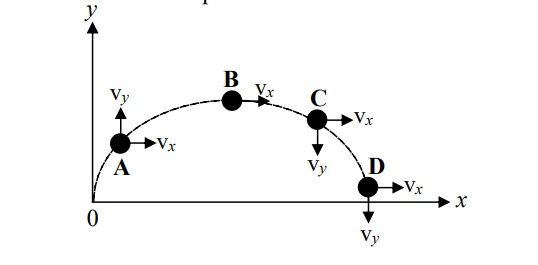
The given diagram shows the projectile motion of a ball, with points A, B, C and D marked along its path. Considering the given situation, the magnitude of the vertical component of velocity will be maximum at point
Q9
The acceleration produced by virtue of changing direction of velocity of an object moving in a circular path is called
Q10
When an object moves with uniform speed in a circular orbit, its centripetal acceleration will be directed
Q11
Missiles I, II, III and IV are launched at , , and , respectively from the launching pad with same initial velocity. The shortest distance will be covered by
Q12
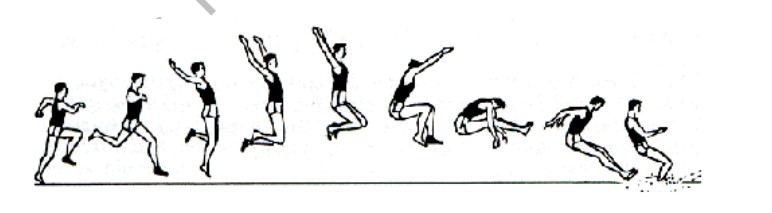
The given figure shows the first attempt of a long jump of an athlete in Olympics. Which of the following factors of the athlete will MAINLY help him to improve his own record in the next attempt?
Q13
A moving truck applies brakes and stops after traveling 20 m. If its kinetic energy was 4000 J, then the average braking force will be
Q14
In a conservative field, the work done in moving a body around a closed loop is always
Q15
A lighter metallic ball () collides with a much heavier metallic ball () which is at rest, and (), then after an elastic collision, the heavier ball () will